
Palm Bay service area
Roof Repair in Tillman Lakes, Palm Bay FL
A southwestern Palm Bay area around Tillman Lakes, with open lots and developing streets where wind exposure and preventative work matter most.
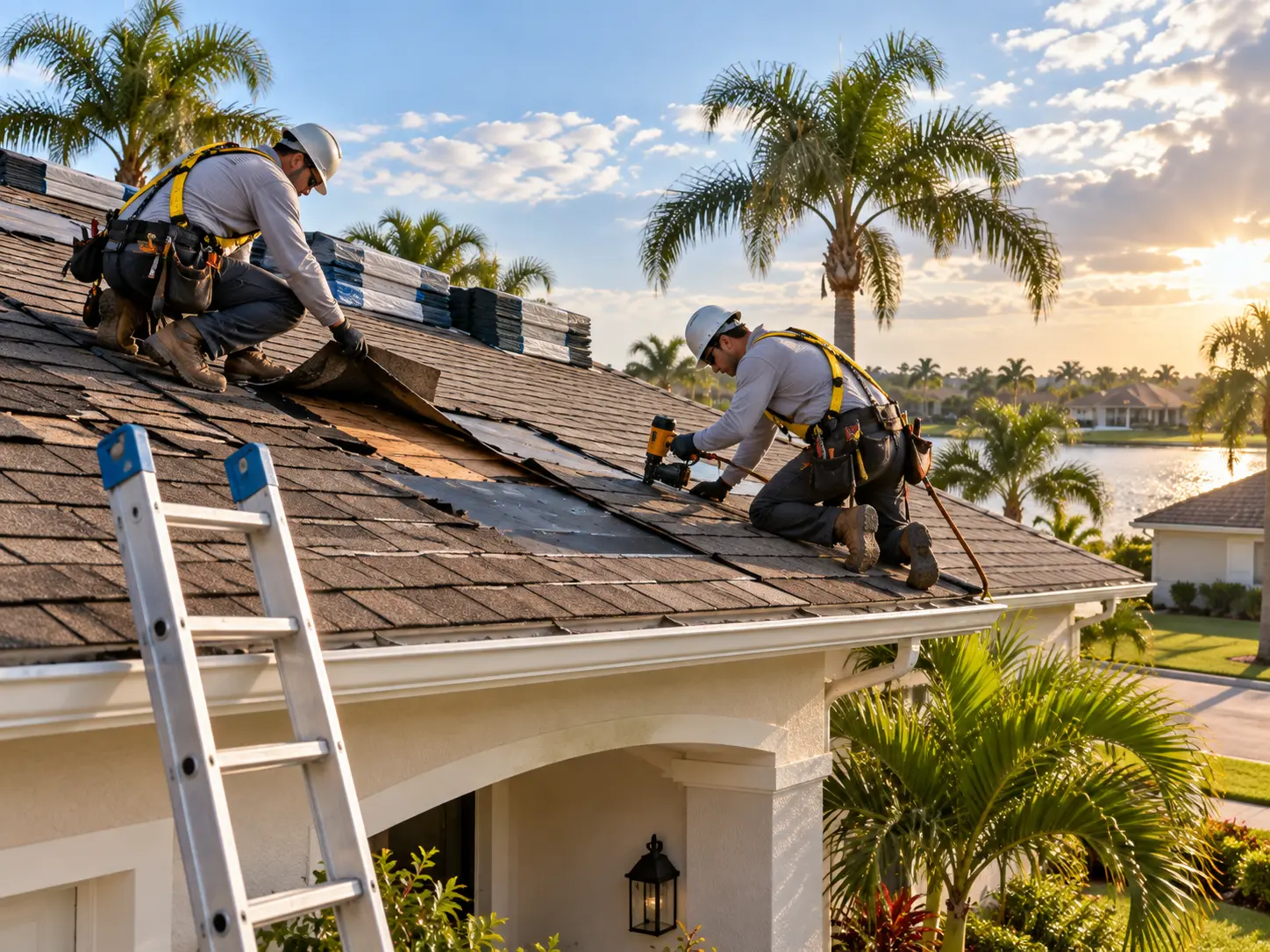
The Tillman Lakes area covers part of southwestern Palm Bay, a section of the city where development is more spread out and lots are generally more open than in the older eastern neighborhoods. Housing here includes both long-established homes and newer construction, sometimes on the same street.
Open ground is the defining roofing factor. Without dense surrounding structures or mature tree cover to break up airflow, wind reaches roofs with less obstruction. That shifts the damage profile toward uplift — lifted shingle edges, displaced ridge caps and roof-edge failures — rather than the impact and debris damage typical of heavily wooded neighborhoods.
Wind exposure on open lots
Wind behaves differently across an open landscape than through a built-up area. There is less turbulence and obstruction, so gusts arrive with more energy at the roof surface, and uplift pressures concentrate where the airflow separates: at eaves, rake edges, ridges and corners.
In practice this means the components that fail first in this area are the perimeter ones. Drip edge, starter courses, rake shingles and ridge caps take the brunt of it. A roof can lose its ridge caps while the field remains entirely undisturbed, and that missing ridge line is an open path for wind-driven rain along the peak.
Broken seals and delayed failures
The damage that matters most in a wind-exposed area is the damage nobody can see. When a gust lifts a shingle enough to break its adhesive bond but not enough to remove it, the shingle settles back looking completely normal while functionally becoming a loose flap.
Roofs in this part of Palm Bay accumulate that condition over successive storm seasons. It explains why a home can lose a run of shingles during an unremarkable afternoon thunderstorm — the seals had already failed months earlier during a stronger event that appeared to cause no damage at all.
Preventative work before the wet season
Because failures here tend to be wind-initiated and progressive, preventative attention pays off more than it does in areas where damage is sudden and obvious. Checking and re-securing perimeter components, confirming ridge and hip attachment, and replacing aging penetration boots before June puts the roof in a much better position for storm season.
The same logic applies to anything loose on or near the roof. Detached gutter sections, lifted flashing legs and unsealed shingle edges all give wind something to work against, and each one is inexpensive to correct in advance.
New and older homes side by side
The mix of housing ages in this area means two very different repair conversations happen on the same street. Newer roofs generally need component-level work: boots, flashing details and post-storm perimeter checks.
Older roofs in an exposed location have usually been through more wind cycles than a comparable roof in a sheltered neighborhood, and their seals reflect that. On those homes the question is more often whether repeated repairs are still the sensible route, which is a decision worth making with inspection evidence rather than by age alone.
Roof repair services in Tillman Lakes
Typical situations homeowners in this part of Palm Bay call about.
Ridge caps missing after a storm
Uplift at the peak, common on exposed lots and an open path for wind-driven rain if left.
Shingles lifted along a rake edge
Wind catching the gable edge, which progresses inward across the slope with each subsequent storm.
Shingle loss in a routine thunderstorm
Almost always seals broken during an earlier, stronger event that appeared to cause no damage.
Drip edge pulled loose at the eave
Leaves the roof deck edge exposed and allows water behind the fascia.
Cracked pipe boot on a newer home
A component failure unrelated to roof age, and one of the most frequent repairs anywhere in Palm Bay.
Roof repair questions from Tillman Lakes homeowners
Why does my roof seem to lose shingles more often than my friend's across town?
Exposure is usually the explanation. A roof on an open lot with little surrounding obstruction takes wind more directly than one tucked among mature trees and neighboring houses, which break up and slow the airflow. Over years, that means more uplift cycles working at shingle edges and more opportunities for seals to break. It does not mean the roof was built worse; it means it lives in a harsher wind environment and benefits from more frequent checks of its perimeter components.
Are ridge caps really that important?
Yes, disproportionately so for their size. Ridge caps close the gap at the peak where two roof planes meet and where any ridge ventilation sits. When they are displaced, wind-driven rain has a direct path into the attic along the length of the ridge, and the exposed edges of the shingle courses beneath them become vulnerable to further lifting. They are also among the first components to move in a wind event, which makes them one of the first things worth checking after any storm.
What should I do before hurricane season if my roof is in an exposed spot?
Have the perimeter and penetrations checked, and correct anything already loose. Specifically: ridge and hip attachment, rake and eave edges, drip edge fastening, the condition of pipe boots, and whether any shingles lift easily by hand. Clear gutters and valleys so heavy rain drains rather than backing up. Secure or remove loose items in the yard. These are inexpensive items individually, and each one removes something the wind could otherwise use as a starting point.
Is it worth repairing wind damage if more storms are coming anyway?
Yes, because damage compounds. An area with lifted or missing shingles gives the next storm an edge to work against, and it spreads outward rather than staying contained. Exposed underlayment degrades quickly under Florida sun and stops functioning as a backup barrier. What starts as a handful of shingles becomes a slope, and eventually a decking repair. Repairing promptly resets the roof to a condition where it can resist the next event instead of failing progressively through the season.
Roof repair services in Tillman Lakes
Roof repair requests for Tillman Lakes
Roof Repair Palm Bay FL160 Malabar Rd SW, Ste 319
Palm Bay, FL 32907
321-485-7104
Roof repair estimate for your Tillman Lakes home
Describe what the roof is doing and the request can be connected with local roofing service providers who handle inspections and repairs.
Roof repair requests accepted 24/7.