
Palm Bay, Florida
Roof Leak Repair in Palm Bay, FL
Tracing an active leak back to its true entry point, then repairing the shingles, flashing or penetration responsible for it.
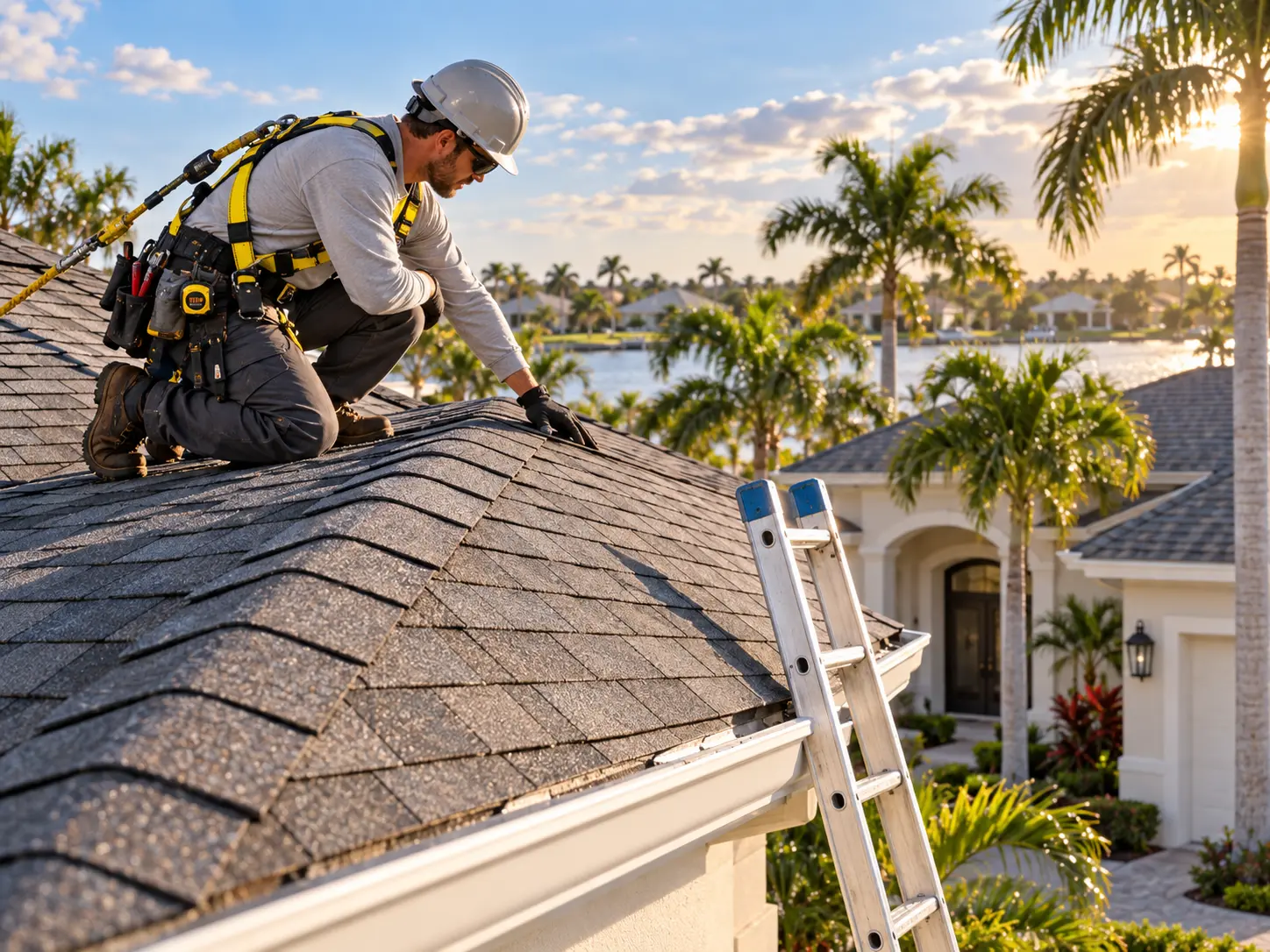
A roof leak almost never announces itself where it actually starts. Water enters at a gap in the roof surface, runs along the underside of the decking or down a rafter, and finally drops through the ceiling several feet from the real problem. That is why leak repair begins with diagnosis rather than sealant. Guessing at the location wastes money and usually leaves the homeowner with a second stain a few weeks later.
Roof leak repair in Palm Bay covers everything from a single lifted shingle over a bedroom to a failed pipe boot above a bathroom or a flashing joint where a porch roof meets an exterior wall. The work is only as good as the inspection behind it, so the first visit focuses on establishing where water is entering, how far it has traveled, and whether the surrounding materials are still sound enough to repair.
What you may notice
Signs of this problem on a Palm Bay roof
Ceiling stains that grow after rain
A ring-shaped brown stain that darkens or widens with each storm indicates water is still entering. A stain that never changes may be from an older, already-corrected leak.
Bubbling paint or sagging drywall
Paint that blisters or drywall that feels soft means water has been sitting in the ceiling assembly long enough to saturate it, not just wet the surface.
Damp insulation or attic staining
Dark streaks on rafters, matted insulation, or rusty nail tips inside the attic often reveal the entry point long before the ceiling below shows anything.
Musty smell in one room
A persistent odor in a closet or corner is frequently the first sign of a slow leak that has not yet produced a visible stain.
Water at an interior wall after wind-driven rain
Leaks that appear only during sideways rain usually trace back to wall flashing, a roof-to-wall transition, or a poorly sealed roof edge rather than the open field of the roof.
Why it happens
Common causes
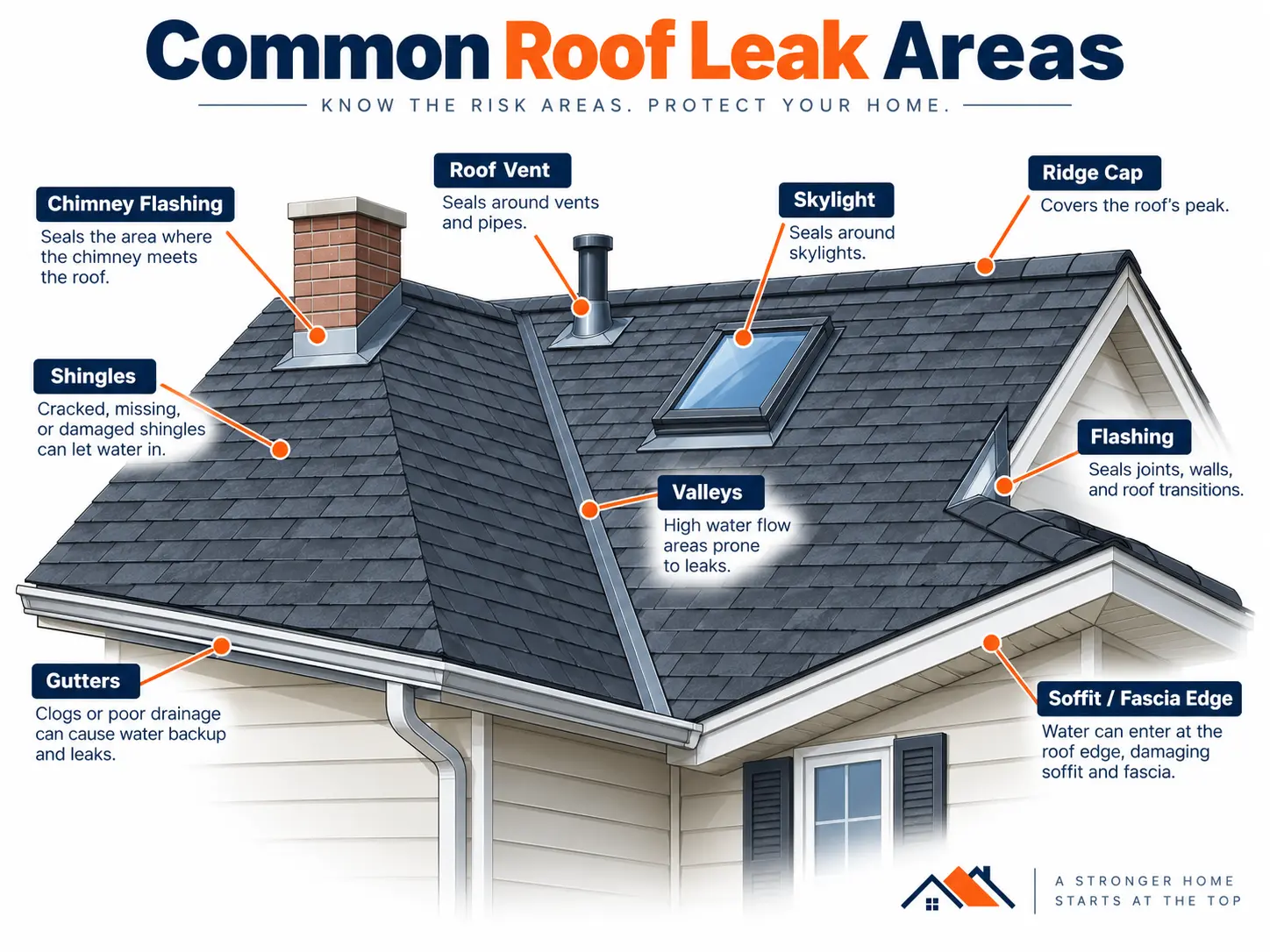
Failed pipe boots
The rubber collar around a plumbing vent hardens and cracks under Florida sun exposure, opening a direct path into the attic. This is one of the most common single-point leaks on shingle roofs.
Displaced or damaged shingles
Wind can lift a shingle tab and break its seal without removing it. The shingle looks intact from the ground but no longer sheds water in a storm.
Flashing separation
Step flashing, counter flashing and chimney flashing rely on correct overlap. Fasteners back out, sealant shrinks, and the joint stops directing water back onto the roof surface.
Valley wear
Valleys carry the combined runoff of two roof planes. Granule loss, debris packing and nail placement too close to the valley center all create leak paths.
Exposed or degraded underlayment
Where shingles have been missing for a while, the underlayment takes direct sun and rain and eventually stops functioning as a secondary barrier.
How the repair is approached
Leak repair starts from the inside. Documenting the interior evidence — where the stain sits, which direction the framing runs, whether the attic shows a wet path — narrows the search area on the roof before anyone climbs a ladder.
On the roof, the suspected zone is examined systematically: penetrations first, then valleys and transitions, then the field of shingles. Fasteners, sealant beads, boot collars and flashing overlaps are checked individually rather than sealed over as a group.
Once the entry point is confirmed, the repair replaces the failed component rather than coating it. A cracked boot is replaced, not smeared with mastic. Damaged shingles are removed and re-installed with proper nailing and sealing, and flashing is re-lapped so water is shed instead of trapped.
Decking under the leak is checked for softness. If the sheathing has lost structural integrity, that section is addressed before new surface material goes down, because a repair over compromised decking will not hold fasteners reliably.
What matters specifically in Palm Bay
Palm Bay roofs deal with a specific combination: intense UV, long humid periods, heavy convective downpours in summer, and wind-driven rain from tropical systems. UV is what ages rubber pipe boots and sealant beads, humidity keeps wet materials from drying between storms, and wind-driven rain pushes water uphill under shingle courses and behind flashing.
Because rainfall here often arrives as a short, extremely heavy burst, small defects show up quickly. A gap that would leak slowly in a mild climate can deliver a noticeable interior drip during a single afternoon storm.
Attic ventilation matters too. Poorly ventilated attics in this climate hold moisture, and condensation on the underside of decking is sometimes mistaken for a roof leak. Ruling that out is part of an honest diagnosis.
Repair or replacement?
Repair is generally reasonable when the leak has one identifiable source, the surrounding shingles or panels are still flexible and well-adhered, and the decking is sound. A single failed boot, one damaged valley section, or a length of separated step flashing all fit that description.
Replacement deserves consideration when leaks keep appearing in different locations, when the field of the roof is broadly brittle or losing granules, or when several areas of decking have already been damaged. At that point each repair is buying a short window rather than solving the problem.
The honest answer usually depends on what the inspection finds, not on the roof's age alone. A repair vs replacement guide is available and walks through the decision in more detail.
What affects the cost
Roof repair pricing depends on inspection findings. These are the variables that move it most.
How long the leak has run
A leak caught after one storm is a surface repair. A leak that has run for months may involve decking, insulation and interior finishes.
Location on the roof
A repair near a walkable eave is faster and safer than one at a steep ridge or above a second-story wall, and access time is part of the price.
Component type
Replacing a pipe boot is a small material cost. Rebuilding chimney or wall flashing involves fabrication, more removal, and more shingle work around it.
Material matching
Older shingle colors and discontinued tile profiles can be difficult to match, which affects both material sourcing and how the finished repair looks.
Hidden damage
Soft decking discovered during removal changes the scope. Good practice is to identify that possibility up front rather than treat it as a surprise.
Step by step
- 1Interior review and documentation of the visible evidence
- 2Attic inspection where accessible to trace the water path
- 3Targeted roof inspection of penetrations, valleys and transitions
- 4Written explanation of the finding and the repair options
- 5Repair of the failed component, including any decking work needed
- 6Water-test or post-repair review of the area

Roof Leak Repair questions Palm Bay homeowners ask
Why is the stain on my ceiling not directly under the hole in my roof?
Water follows the path of least resistance once it gets past the roof surface. It can travel along the top of the decking, run down a rafter, cross a truss chord, and drop several feet away from where it entered. On a low-slope section it can travel even further. This is the single biggest reason leak repair should start with an inspection instead of sealant. Repairing directly above the stain often means repairing an area that was never leaking, while the true entry point keeps letting water in.
Can a roof leak be repaired while the roof is still wet?
A temporary measure such as tarping can be installed in wet conditions when it is safe to do so, but most permanent repairs need a dry, stable surface. Sealants and shingle adhesives do not bond correctly to wet material, and walking a wet or storm-damaged roof is genuinely dangerous. The usual sequence during an active weather event is to stabilize the area first, then return for the permanent repair once conditions allow the work to be done properly.
How quickly should I act on a small leak?
Sooner is significantly cheaper. The roof surface repair itself rarely changes much in price over a few weeks, but what sits underneath does. Saturated insulation loses its performance, decking softens, drywall stains spread, and in a humid climate microbial growth becomes a possibility. A leak that would have been a straightforward component replacement can turn into a repair that also involves sheathing and interior finishes if it is left through a full rainy season.
Will you be able to find the leak on the first visit?
Often, because many residential leaks trace back to a short list of usual suspects: pipe boots, flashing, valleys, damaged shingles and roof edges. Some leaks are harder — intermittent leaks that only appear with wind from one direction, or leaks in complex roof intersections — and those may require a water test or a return visit during specific conditions. A trustworthy inspection will acknowledge when a diagnosis is not yet certain rather than propose a repair based on a guess.
Does a leak always mean I need a new roof?
No. Many leaks are single-point failures on roofs that are otherwise performing well, and replacing an entire roof because of one cracked boot would be a waste of money. What matters is whether the failure is isolated or symptomatic. If the inspection shows one bad component surrounded by sound material, repair is the sensible route. If it shows widespread brittleness, multiple prior leak locations, or extensive decking issues, then replacement becomes the more honest recommendation.
Get a roof repair estimate for your Palm Bay home
Describe what the roof is doing and the request can be connected with local roofing service providers who handle inspections and repairs.
Roof repair requests accepted 24/7.