Palm Bay, Florida
Metal Roof Repair in Palm Bay, FL
Repairs for exposed-fastener and standing-seam metal roofs, including backed-out screws, failed washers, seam separation and panel damage.
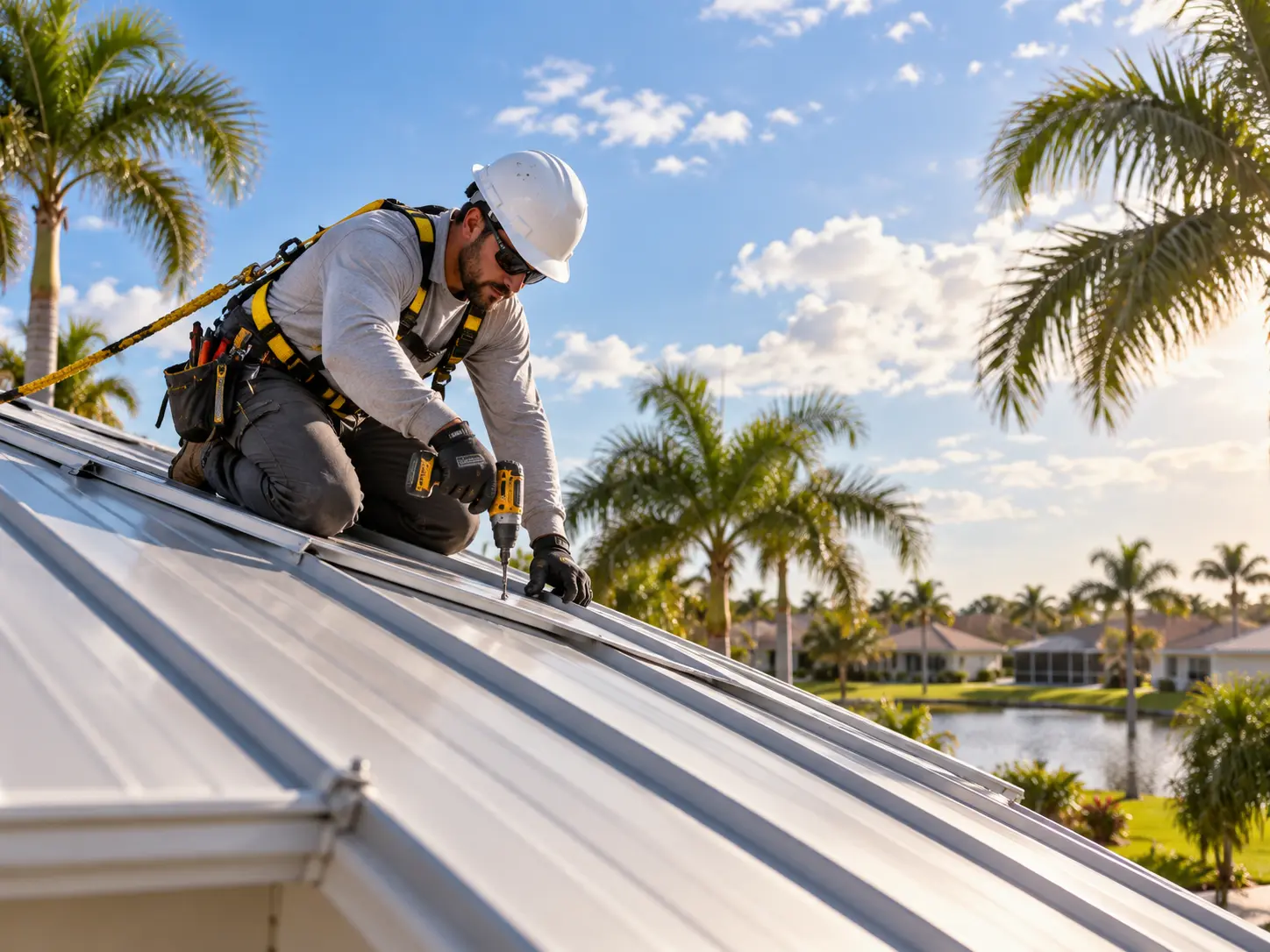
Metal roofing has become common across Palm Bay for good reasons: it handles wind well, sheds water quickly, and lasts a long time when installed correctly. But metal roofs do not fail the way shingle roofs do. Instead of losing covering, they usually develop problems at the points where the system is fastened, joined or penetrated.
The two main residential types behave differently. Exposed-fastener panels rely on thousands of screws with rubber washers, and those washers are the wear item. Standing-seam systems hide their fasteners under interlocking seams, so their failure points tend to be at terminations, penetrations and any place the seam has been disturbed. Correct repair depends on knowing which system is on the roof.
What you may notice
Signs of this problem on a Palm Bay roof
Visible screw heads standing proud of the panel
Screws that have backed out leave a gap under the head and a compressed washer that no longer seals against the panel.
Rust streaks below fasteners or seams
Orange staining running down a panel usually starts at a fastener, a cut edge or a scratch that has broken the protective coating.
Leaks that only appear in wind-driven rain
Metal roofs shed vertical rain easily. Leaks that only show up in sideways rain point to seams, end laps, or flashing terminations.
Oil canning that has become distortion
Mild waviness is cosmetic and normal, but panels that have deformed at the fastener line have lost clamping force.
Separated or lifted seams
A standing seam that has opened, or a panel lap that has pulled apart, breaks the continuous water path down the roof.
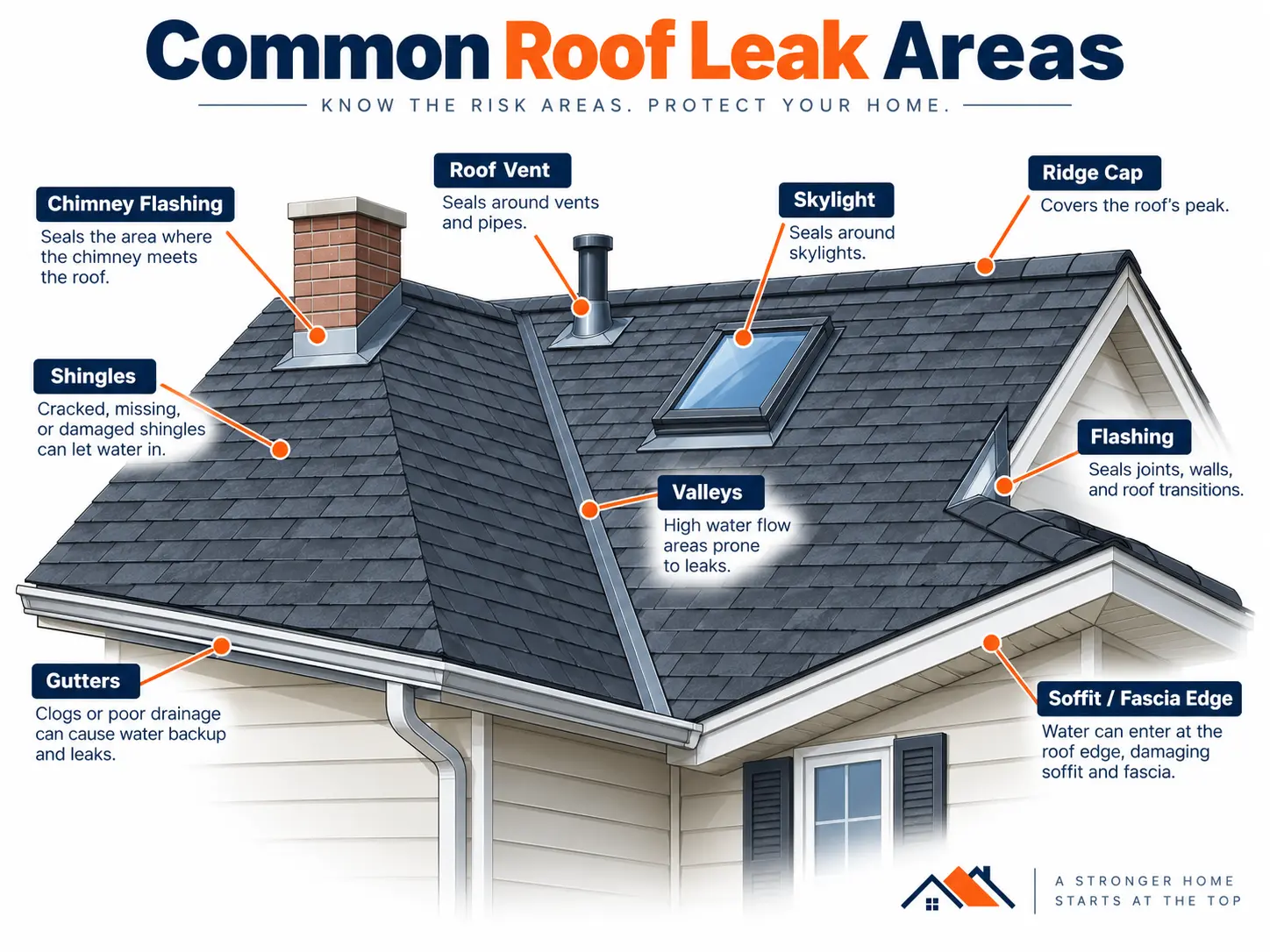
Damaged pipe flashing on a metal roof
The flexible boots used at penetrations on metal roofs harden and crack in the same way shingle boots do, and often sooner because panel temperatures run higher.
Why it happens
Common causes
Thermal movement
Metal expands and contracts significantly with temperature. Over years of daily cycling, that movement works fasteners loose and stresses seams and terminations.
Washer degradation
The EPDM washer under an exposed fastener is the actual seal. UV and heat harden it until it can no longer compress against the panel.
Over- or under-driven screws
Screws driven too hard crush the washer; screws left loose never compress it. Both leak, sometimes years after installation.
Coating damage and corrosion
Scratches from debris, foot traffic or trimming expose bare steel. Near the coast, salt in the air accelerates what follows.
Incompatible metals or fasteners
Dissimilar metals in contact can drive galvanic corrosion, which shows up as pitting around fasteners or at flashing joints.
How the repair is approached
The roof is walked carefully — metal is slippery and panels can be damaged by careless footing — and the fastener pattern, seams, terminations and penetrations are inspected individually.
Backed-out or failed fasteners are replaced, typically with a larger-diameter screw and a new washer so the new fastener bites fresh material rather than a stripped hole. Blanket re-screwing may be recommended when the failure pattern is widespread rather than isolated.
Seam and lap issues are addressed according to the panel system. Some are re-crimped or re-fastened; others need butyl tape and a properly formed lap. Sealant alone across an open seam is a short-term measure, not a repair.
Penetrations get new boots or flashing designed for metal profiles, formed to the rib pattern rather than mashed onto it. Corrosion spots are cleaned and treated, and badly corroded panels are replaced rather than coated over.
What matters specifically in Palm Bay
Panel temperatures on a Palm Bay metal roof swing dramatically between a hot afternoon and a sudden rainstorm. That rapid contraction is exactly the condition that loosens fasteners over time, which is why fastener maintenance matters more here than in milder climates.
Proximity to the Indian River Lagoon and the Atlantic means salt-laden air reaches many parts of the city. Salt accelerates corrosion wherever a coating is compromised, so scratches and cut edges that would be minor elsewhere deserve attention here.
Metal roofs generally perform very well in tropical wind, but their weak points are terminations — ridge, eave, gable ends and around penetrations. Post-storm inspections should focus there rather than on the field of the panels.
Repair or replacement?
Repair is usually the right answer when panels are structurally sound and the problems are at fasteners, seams, boots or flashing. Metal panels commonly outlast their fasteners by decades, and a re-fastening program can add substantial service life.
Replacement warrants consideration when corrosion has perforated panels in multiple areas, when the panel profile has been deformed across large sections, or when fastener holes have been enlarged so many times that new screws no longer hold.
Partial panel replacement is often practical on metal roofs in a way it is not on shingles, because individual panels can sometimes be removed and replaced without disturbing the whole slope.
What affects the cost
Roof repair pricing depends on inspection findings. These are the variables that move it most.
Panel system type
Standing-seam repairs generally take more time and specialized handling than exposed-fastener work.
Number of fasteners involved
Replacing a dozen screws is minor; re-fastening an entire slope is a project.
Panel availability
Matching an older profile, gauge and color may require ordering, and some profiles are no longer produced.
Extent of corrosion
Surface treatment is inexpensive; perforated panels require replacement sections.
Access and pitch
Steep metal roofs need more fall protection and slower, more careful work.
Step by step
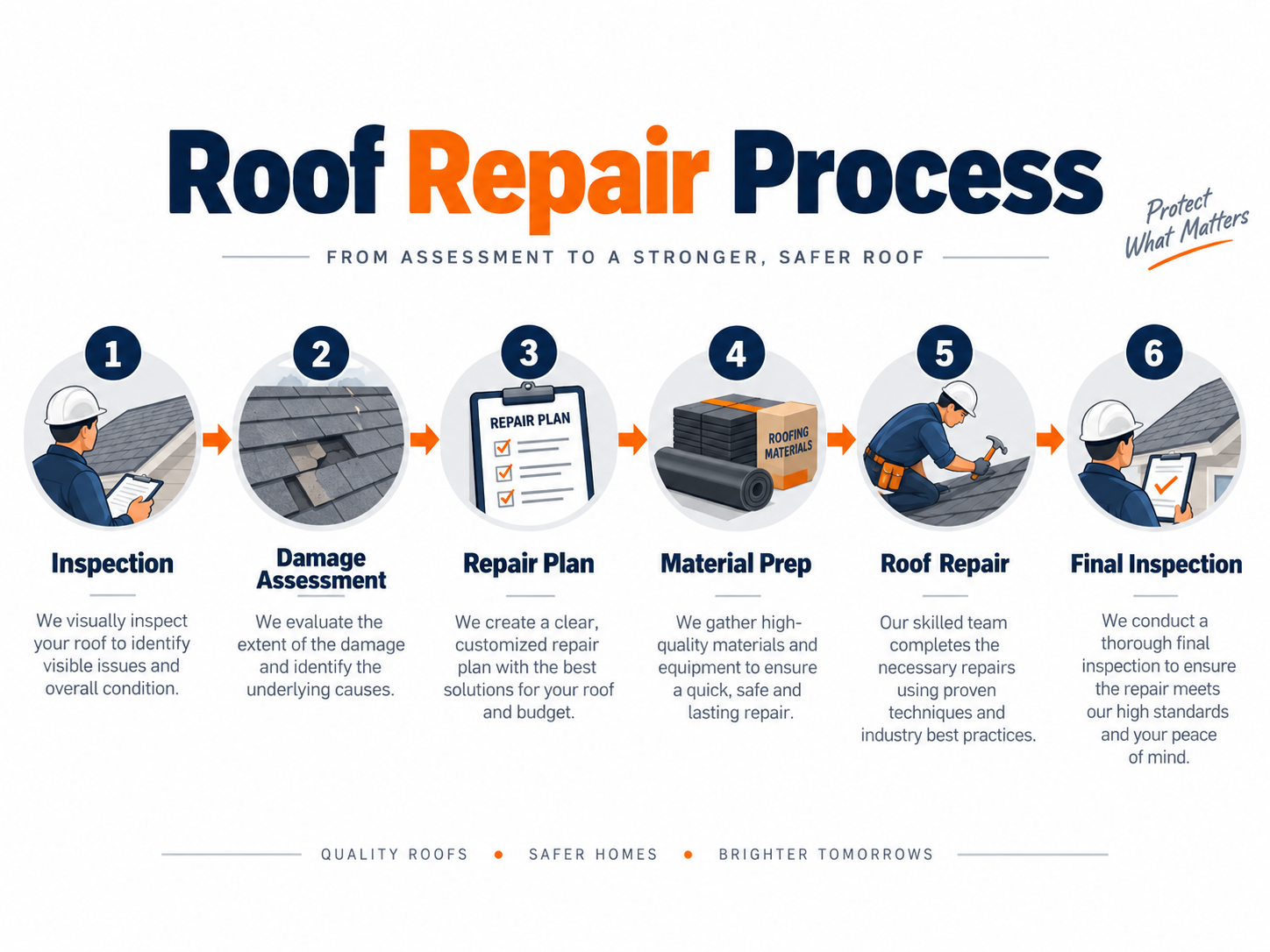
- 1Identify the panel system and fastening method
- 2Inspect fasteners, seams, terminations and penetrations
- 3Document corrosion, deformation and any panel damage
- 4Replace failed fasteners and boots, and repair or re-form seams
- 5Treat coating damage and replace unsalvageable panels
- 6Final review of terminations and water path
Metal Roof Repair questions Palm Bay homeowners ask
How often do exposed fasteners need attention on a metal roof?
There is no single interval, but the rubber washers under exposed screws are consumable parts and they do not last as long as the panels. Many roofs in this climate start showing washer failures somewhere in the ten-to-twenty-year range, and it often happens gradually across a slope rather than all at once. Having the fastener pattern inspected every few years, particularly after strong storms, catches the problem while it is still a screw replacement instead of a leak with decking damage behind it.
Can a leaking metal roof just be coated?
Coatings have a legitimate place, mainly on low-slope metal where the whole surface is being renewed as a system. They are a poor substitute for finding and fixing a specific leak. Coating over a backed-out fastener or an open seam hides the defect without restoring the mechanical connection, and when the coating eventually cracks at that flex point the leak returns, now harder to locate. Fix the failed component first; consider a coating separately, on its own merits.
Is a small rust spot on my metal roof a problem?
It depends on whether the coating breach goes through. Surface staining that wipes or washes away is often just runoff from something else — a fastener, a vent, a piece of debris. Actual rust on the panel means the protective coating has been compromised, and in salt-influenced air near the lagoon that will continue to progress. Small spots can be cleaned and treated. Left alone for years, they can eventually perforate the panel and turn a maintenance item into a panel replacement.
Why does my metal roof only leak in heavy wind?
Because metal panels shed vertically falling rain extremely well, and the failure points are mostly horizontal or lateral. Wind-driven rain gets pushed up under end laps, sideways into seam terminations, and behind flashing at gable ends and around penetrations. A leak that appears exclusively during storms with strong wind from a particular direction is a strong clue about where to look, and it is worth telling the inspector which direction the wind was coming from.
Can walking on my metal roof cause damage?
Yes, which is why access matters. Panels are supported at their ribs and at the framing beneath; stepping in the wrong place can dent or deform the flat pan, and deformation near a fastener reduces the clamping force that keeps the seal tight. It is also genuinely slippery, especially when damp or dusty. If you need to know whether something is wrong with your metal roof, that assessment is better handled by someone with the fall protection and the knowledge of where the panel can carry weight.
Related roof repair services
Palm Bay areas covered
Get a roof repair estimate for your Palm Bay home
Describe what the roof is doing and the request can be connected with local roofing service providers who handle inspections and repairs.
Roof repair requests accepted 24/7.