
Palm Bay, Florida
Flat and Low-Slope Roof Repair in Palm Bay, FL
Membrane repairs for flat and low-slope sections: seam splits, punctures, blisters, ponding water and failed drainage details.

Flat roofs are not actually flat — they are low-slope surfaces designed to move water toward a drain or edge, and their entire performance depends on a continuous membrane rather than on overlapping pieces that shed water. That single difference changes everything about how they fail and how they are repaired.
In Palm Bay, low-slope sections most often appear over porches, additions, carports and Florida rooms attached to otherwise sloped homes. Those transitions between a steep roof and a low-slope section are among the most leak-prone assemblies on a residential property, because they combine concentrated runoff with a change in system type.
What you may notice
Signs of this problem on a Palm Bay roof
Standing water more than 48 hours after rain
Persistent ponding indicates a drainage or slope problem and accelerates membrane aging in the affected area.
Splits or open seams
Membrane seams are the weakest line in the system, and a split there admits water across a long path.
Blisters and bubbles
Trapped moisture or air under the membrane expands with heat, stressing the material until it eventually opens.
Punctures and scuffs
Dropped tools, debris, foot traffic and rooftop equipment servicing all puncture membranes.
Deteriorated edge metal or termination bar
Where the membrane terminates at a wall or edge, a failed termination lets water behind the whole system.
Interior staining across a wide area
Because water spreads under a membrane, low-slope leaks often produce broad staining rather than a single drip point.
Why it happens
Common causes
Inadequate slope or blocked drainage
If water cannot get off the roof, it sits, and standing water finds every imperfection given enough time.
Seam failure
Heat-welded, adhered or taped seams degrade with UV, movement and age, and they are the first place a membrane opens.
UV degradation
Florida sun is hard on exposed membranes, particularly older or unprotected materials.
Thermal movement and building settlement
Membranes are stressed where they cross structural joints or meet walls that move differently than the deck.
Mechanical damage
Foot traffic for servicing air conditioning equipment is one of the most common sources of puncture damage on residential low-slope roofs.
How the repair is approached
The first task is finding the actual breach, which is harder on a membrane roof than on a sloped one because water travels laterally under the membrane. Inspection focuses on seams, terminations, penetrations, and any area of ponding.
Repairs are made with materials compatible with the existing membrane. Patching a TPO roof with an incompatible product, or covering a modified bitumen split with an unbonded coating, produces a repair that separates.
Blisters are cut open, the substrate is dried where possible, and the area is re-covered with a properly adhered patch that extends well beyond the affected zone rather than just spanning it.
Drainage is addressed as part of the repair. If the leak is caused by water sitting where it should not, patching the membrane without correcting the ponding just relocates the next failure.
What matters specifically in Palm Bay
Palm Bay's summer rainfall arrives in short, high-volume bursts. A low-slope roof that drains slowly under normal rain can be overwhelmed by a single afternoon storm, so drainage capacity matters more here than in areas with gentler rainfall patterns.
Sustained heat and UV shorten membrane life across the board. Reflective surfacing and coatings, applied as a planned system rather than as a leak patch, can meaningfully reduce surface temperatures.
Many low-slope areas here sit over porches and Florida rooms with limited attic space above them, which means leaks reach the interior finish quickly and there is little room to inspect from below.
Repair or replacement?
Repair is appropriate when the membrane is generally intact and the problems are localized: one seam, a puncture, a failed termination, a blister or two.
Replacement or a full recover system deserves consideration when the membrane has widespread crazing and brittleness, when multiple seams are opening, or when the insulation beneath has become saturated across large areas.
Saturated insulation is the deciding factor more often than the membrane itself. Wet insulation does not dry in place, loses R-value permanently, and keeps the deck damp regardless of how well the surface is patched.
What affects the cost
Roof repair pricing depends on inspection findings. These are the variables that move it most.
Membrane type
TPO, EPDM, modified bitumen and built-up systems each require different materials and techniques.
Size and number of repair areas
One patch is quick; multiple failures spread across a roof become a system-level decision.
Whether insulation is wet
Removing and replacing saturated insulation is a significant part of any larger low-slope repair.
Drainage corrections
Adding or reworking drains, scuppers or tapered insulation is separate from membrane work.
Access and equipment
Rooftop mechanical equipment and limited access both slow the work.
Step by step
- 1Survey the surface for ponding, seams, punctures and terminations
- 2Identify the membrane type and confirm compatible repair materials
- 3Probe for soft or saturated areas beneath the membrane
- 4Repair the breach with a properly adhered, oversized patch
- 5Correct drainage obstructions and terminations
- 6Flood test or observe the area during rainfall where practical

Flat & Low-Slope Roof Repair questions Palm Bay homeowners ask
Is standing water on a flat roof always a problem?
Water that clears within a day or two after rain is generally acceptable and hard to avoid entirely on a low-slope roof. Water that is still there several days later is a genuine issue. Persistent ponding accelerates UV and chemical breakdown of the membrane, adds structural load, attracts debris and algae growth, and makes any small defect far more likely to become a leak. It usually indicates inadequate slope, a blocked drain, or a deflection in the deck that should be addressed rather than tolerated.
Why is my flat roof leak so hard to locate?
Because a membrane roof is a continuous sheet, and once water gets under it there is nothing to stop it moving sideways. Water can enter at a seam on one side of the roof, travel across the insulation layer, and appear at a ceiling opening many feet away. Sloped roofs at least channel water downhill in a predictable direction. On low-slope roofs, locating the breach may require systematically inspecting all seams and terminations, probing for wet insulation, or in some cases a flood test.
Can a coating fix my flat roof?
A coating can be an excellent renewal system for a membrane that is aged but fundamentally intact and dry underneath. It is a poor way to fix an active leak. Coating over an open seam or a wet substrate seals moisture in, and the coating will crack at the same flex point that failed before. The correct sequence is to repair the defects, confirm the insulation is dry, and then consider a coating as a planned surface renewal rather than as an emergency measure.
What causes blisters on a flat roof?
Blisters form when air or moisture becomes trapped between layers of the roof assembly — between the membrane and the substrate, or between plies in a built-up system. Heat expands that trapped volume, pushing the membrane upward. Over repeated daily cycles the blister grows and the material at its edges fatigues. A small, stable blister may not need immediate action, but one that is growing, or one located in a traffic path where it can be stepped on and split, should be cut open, dried and patched.
Does the low-slope section over my porch need a different repair than the main roof?
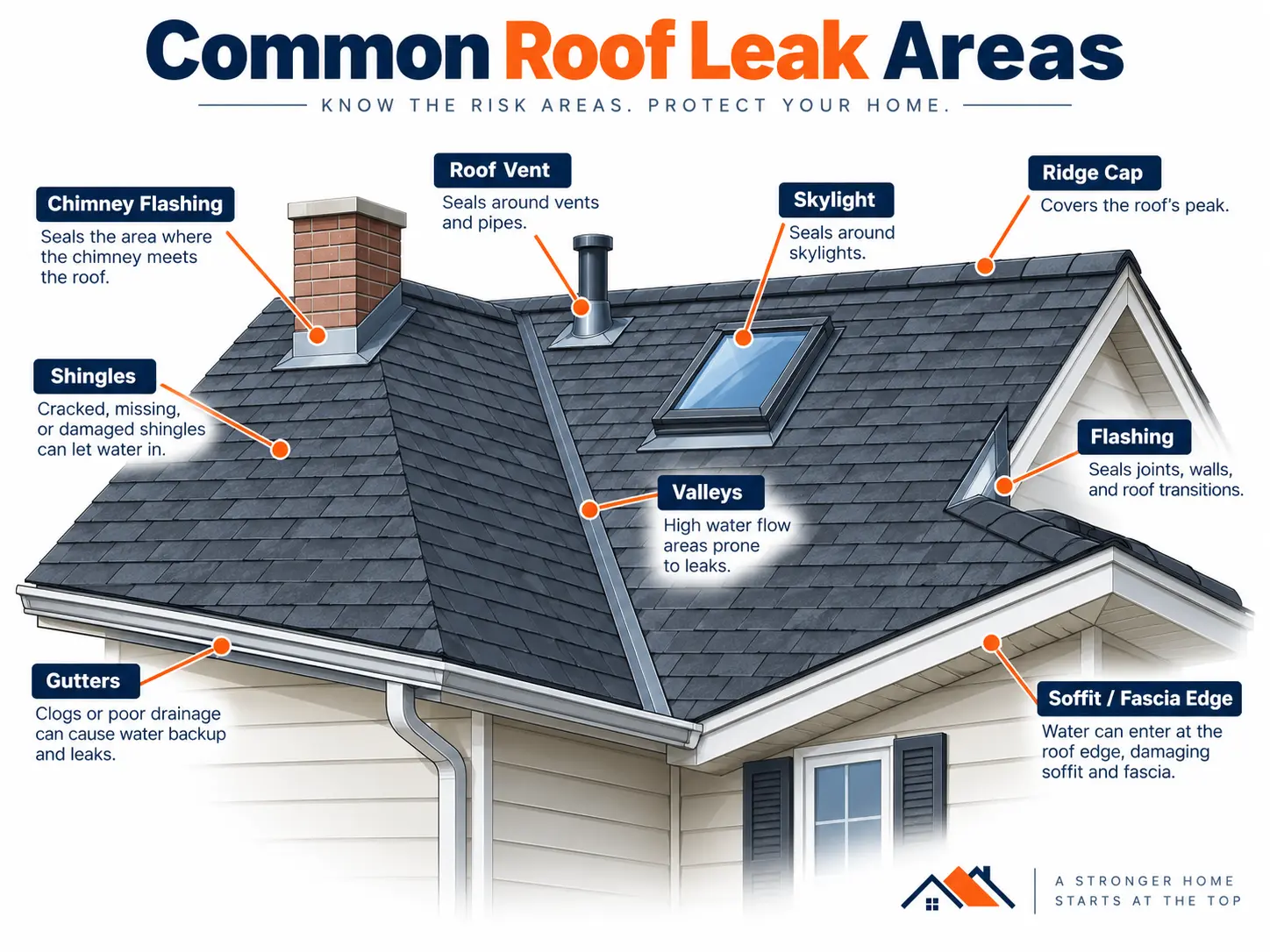
Yes, and the junction between them needs specific attention. The two systems handle water differently, and the transition — where a sloped roof discharges its runoff onto a low-slope surface — concentrates a lot of water in one place. That detail requires proper flashing, adequate membrane run-up under the sloped covering, and often a kick-out or diverter. Leaks at porch and Florida room roofs very frequently originate at that junction rather than in the middle of either roof.
Get a roof repair estimate for your Palm Bay home
Describe what the roof is doing and the request can be connected with local roofing service providers who handle inspections and repairs.
Roof repair requests accepted 24/7.